
A lot of companies still run their data pipelines on SSIS. It works, but it is ageing. Moving everything to a modern platform like Databricks is the obvious next step. The catch is that it takes time, people, and patience.
So we asked a simple question. What if AI could take on the boring part of that migration?
We built a proof of concept to find out. Here is what we learned.
An SSIS package is really just a set of instructions stored in a file. Our accelerator reads that file and rebuilds it for Databricks. The flow looks like this:
The trick is in step two. Instead of asking the AI to translate a whole package at once, we feed it one small component at a time. Each piece gets its own checkpoint. That keeps the output stable and makes the result easy to follow.
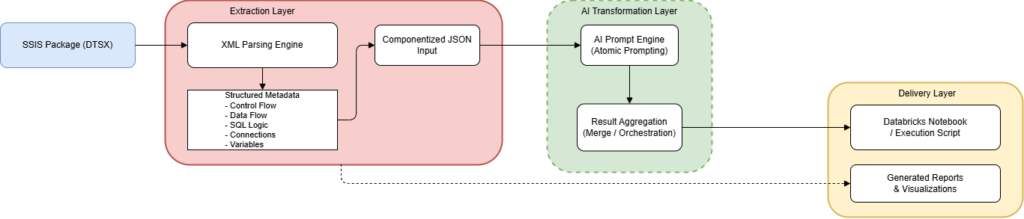
The accelerator does not just hand back code. It also produces a report. The report:
There is a bonus too. The model can suggest small logic improvements along the way. It is still early, but we see this growing into a real feature.
Not every AI model is up to the job. We tested a few:
The lesson is clear. The model you pick decides how much value you actually get.
Some things translated smoothly. Others needed a human eye.
The generated code needed almost no debugging. The few tweaks we made were about the environment, not AI mistakes. Think of a serverless setup or a small datatype change.
What the human really does is validate and configure. You confirm the logic, set up the connections, and sign off on quality. The AI does the heavy lifting. The engineer makes sure it lands.
A few things shape the outcome. Cost scales with package size, since larger packages use more tokens. And because these models are not European, data privacy needs a careful look.
This POC turned a tedious migration into something faster and clearer. It is an accelerator, not a replacement. The technology works. It just needs the right hands around it.
AI does the translation. People do the thinking. That balance is where the real value sits.